
Snapari
A card game you play outside.
- Platforms
- iOS · Android
- Year
- 2026
- Status
- Live
- Built with
- SwiftUI · Kotlin · Postgres · TypeScript · Python
- Website
- getsnapari.com
- Download
- App Store Google Play
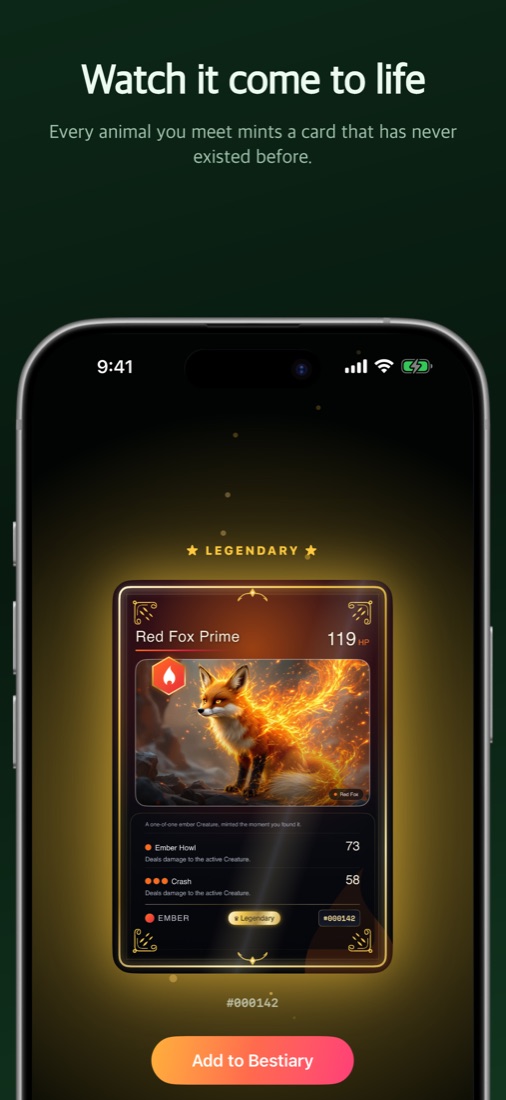
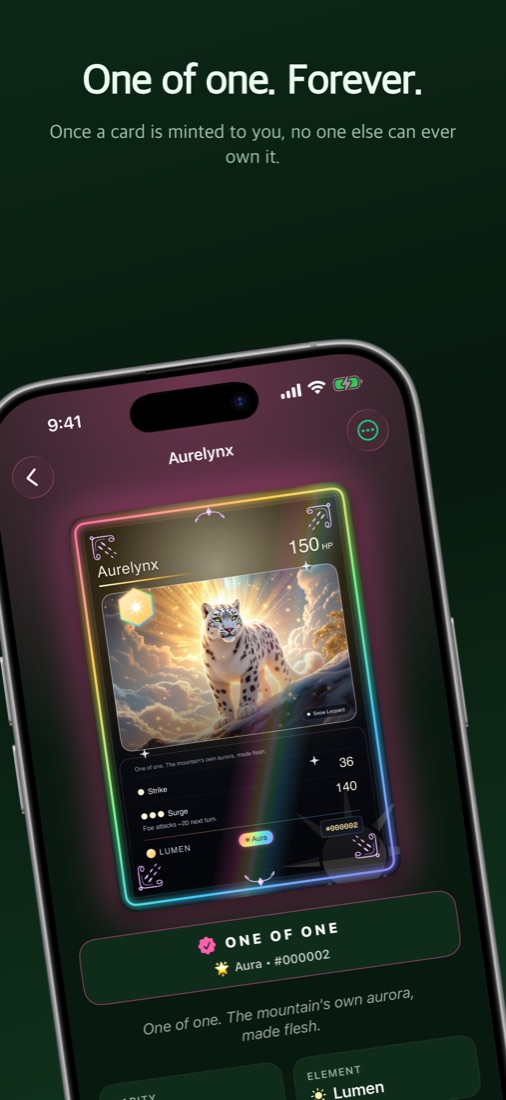
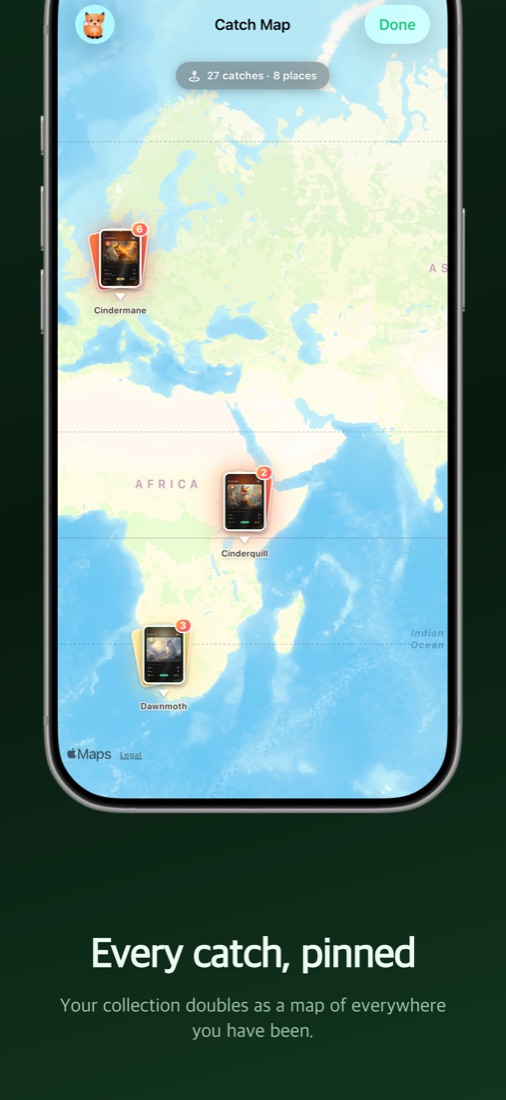
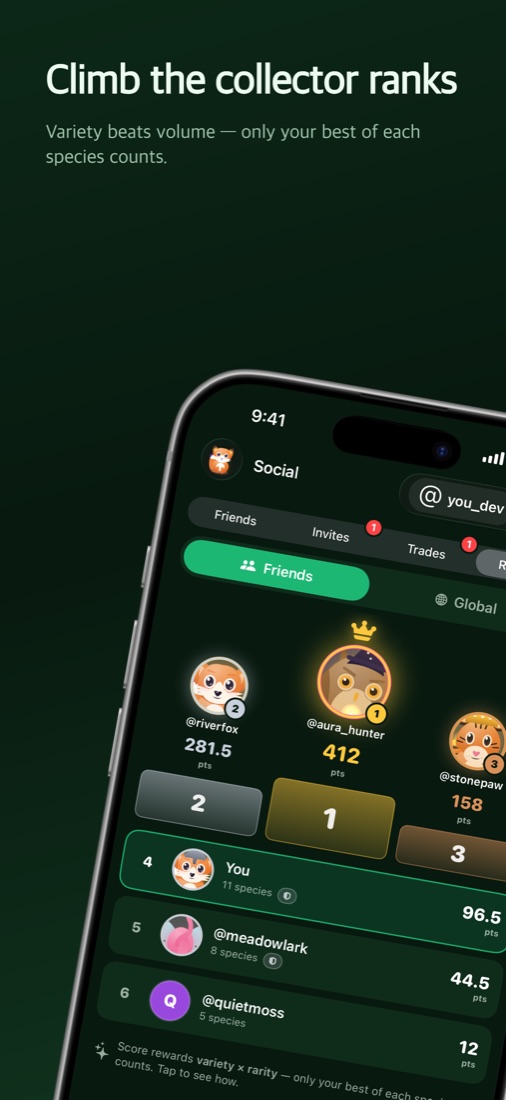
Snapari is a card game you play outside. You take a photo of an animal and, if the server accepts it, you get a card with a serial number nobody else has. It's out on iPhone and Android.
Most of the work is in the few seconds after a photo is uploaded. The server has to decide whether there's a live animal in it, which species it is, and how rare that species is. These are our notes on each part, with the numbers from our test set as of early November 2026.
Recognising the animal
Players photograph everything: cats on sofas, spiders in corners, gibbons at the far end of an enclosure, plush toys, empty ponds. The animal is often small, blurry or half hidden, and the light is usually bad.
We started with a general vision-language model on its own. It reads a scene well and writes the names people actually use, down to a dog's breed. On less common species it guesses, and it sounds sure when it does. A crab came back as a sea urchin and a magpie as a grackle.
Biology models trained across the tree of life have the opposite profile. They know far more species, but they can't tell a live animal from a picture of one, they know nothing about breeds, and their scores are spread thin, so the right answer is often not a confident one.
What we shipped uses both, running on our own hardware for the specialised part. Each model covers for the other's weak spots, and the photo is only accepted when they're consistent enough.
- 1
Photo
Taken and cropped on the phone.
- 2
Species candidates
A biology model suggests which animals it could be.
- 3
Checks and naming
A general model decides whether this is a real, live animal, and names it with those candidates in mind.
- 4
Card or refund
A card when the answer is solid. Otherwise the photo is rejected and the player gets the throw back.
| Setup | Right cards | Wrong species | Fakes stopped | Median time |
|---|---|---|---|---|
| Both models (shipped) | 88/108 | 9/97 | 15/17 | 4.7 s |
| General model alone | 82/108 | 18/100 | 14/17 | 3.1 s |
| Biology model alone | 50/108 | 58/108 | 0/17 | 1.4 s |
Combined, wrong species names drop by half, at the cost of a few more rejected photos.
We also found that the general model isn't stable on hard photos. In an early test it gave different answers to the same photo from one run to the next, each time saying it was 85 to 90% sure. A model's own confidence can't be the only thing deciding whether a card gets minted.
Photos of screens
The easiest way to cheat is to point the phone at a lion on a laptop. The models catch most of these, but we wanted another kind of check that doesn't rely on a model's judgement.
When a camera photographs a screen, the screen's pixel grid and the sensor's grid interfere and leave moiré in the image. You often can't see it, but it shows up clearly in the 2-D Fourier spectrum. A normal photo has a smooth spectrum that falls off roughly as 1/f². A photo of a screen has sharp, isolated peaks on top of that. They are often stronger in the colour channels than in brightness, because a screen's red, green and blue subpixels sit in stripes.
The hard part is real photos. Fur, feathers, leaves, fences and the phone's own image processing produce peaks of their own, so most of the work goes into telling those apart from a screen. We tune it against the same hand-labelled photos as the recognition.
Deciding what's rare
A collection game needs rarity, and for animals there's no list to look it up in. Population estimates exist for only some species, and the main source can't be used commercially. Public sightings don't help much either, since they mostly track how many people are out looking. GBIF has over 520,000 open red fox records for Switzerland alone, many of them from camera traps.
We ended up using three separate measures.
Rarity among players
A species' tier, from Widespread to Mythic, comes from how many different players have caught it. Catching the same cat fifty times, or passing a card between accounts, doesn't make it look rarer or more common.
Wild or zoo
Each species has a field guide page built from open data (GBIF, Wikidata, PhyloPic). Sightings per country tell us whether an animal lives wild where it was caught. The data needs cleaning first, because zoo photos leak into it: at the end of October GBIF had 11 lion sightings in the US, one of them from the Pittsburgh Zoo's lion house.
Each card exists once
Uniqueness is enforced by the database itself. Under parallel load tests we saw no duplicate serials.
Let's Discuss Your Project
Ready to explore what AI can do for your organisation? Book a free 30-minute call, no commitment, just a conversation.